
How to write a thesis with the Environmental and Sustainable Information Systems research group
Process
We follow a deliberate process in supervising and tutoring you towards completion of your thesis. You will receive close supervision and regular feedback from us. We are committed to making sure that you complete your thesis successfully and that everybody walks away satisfied with the process.
To do that we follow a structured approach that provides you with early feedback and encourages you to work continuously throughout the course of your thesis. We will meet with you every or every other week while you are writing your thesis to give you the needed feedback.
At the outset of your thesis, you are encouraged to create a project plan. You will likely not fulfill this as planned, but it helps you estimating your efforts and remaining work. For this project plan, include the following steps depending on whether you write a Master’s or a Bachelor’s thesis:
Master thesis
- Proposal: You are required to write a proposal. More on this below but the proposal is only one page long. We will run through a maximum of three iterations with your proposal. You will receive feedback on your proposal. After each round of feedback, we ask you to resubmit a revised version. It is not allowed to use AI for the proposal!
- Introduction, related work and method: After a period agreed upon with your supervisor, you will hand in the introduction, your related work section and your methods section (for more details, see below). You will then receive feedback and hand-in a revised version. This version will be graded and counts between 10% and 30% towards your final grade (details to be discussed with supervisor). This grade is final. The purpose of this approach is to motivate you to work continuously on our thesis to avoid unpleasant surprises towards the end. This has shown to be effective and you already know early on, in what direction your grade might go.
- Data & Results: A few weeks before your deadline, subject to discussion with your supervisor, you are required to hand in your data & results chapter. You will then receive feedback on this chapter to improve it before final submission.
- Discussion and Conclusion: These two sections remain to be written before submission. They count between 15% and 30% towards your final grade (details to be discussed with supervisor).
Bachelor thesis
- Proposal: You are required to write a proposal. More on this below but the proposal is only one page long. We will run through a maximum of three iterations with your proposal. You will receive feedback on your proposal. After each round of feedback, we ask you to resubmit a revised version. It is not allowed to use AI for the proposal!
- Data collection plan: A few weeks after the registration (subject to discussion with your supervisor), you will have to submit your data collection plan. That means that we want to see a structured approach that tells us where you will get your data from and how exactly you are planning to collect it. This includes a detailed plan with dates and sources. Make sure to come well prepared to this meeting.
- Data evaluation: A few weeks before your final submission (subject to discussion with your supervisor), you are asked to submit the collected data and we will discuss the analysis required and the related work to look at. You can then start your final analysis and write your thesis. The analysis will usually be quite descriptive so that it should be easy enough to complete in the allotted time.
It is your responsibility to keep track of the deadlines you agree to with your supervisor and to clarify them in case of doubt.
We choose to adopt this approach to help you with a smooth process of working through your thesis that allows you to complete it in several stages. This is meant to reduce the burden of submitting one large piece work.
What is research?
Conducting research means that you generate new and generalizable knowledge. While it might seem unconventional, we will make this point by describing a few instances of what is not research:
- Building a tool or writing software is not research.
- Describing a problem and simply proposing a solution out of thin air is not research.
- Applying an existing theory to another context that is not in some way fundamentally different than the ones that already exist is not research.
- Enumerating papers with similar topics without describing what we can learn from the comparison is not research.
We are not expecting you to win a Nobel price with your thesis (would be cool though…) but we expect you to show the ability of working scientifically. That means, make reference to the existing literature, structure your research according to the academic discussion by using appropriate theories or existing models, make sure to use an appropriate scientific method, discuss to what extend your results generalize to other cases and make sure that some generalization is possible and embed your results in the existing literature. You will learn more on this throughout this guideline.
Registering (Anmelden)
We are committed to registering you as soon as possible. This is meant to protect you from working beyond what is expected of you on your thesis. At the same time, this is meant to discipline you to get to work! We need you to work with us to ensure that this is possible. When you do register, you are required to provide a title for your thesis. We are very flexible in regards to this. You are free to choose a title that is reasonably based on what you are doing in the way that the title reflects something that you would like potential future employers to notice later in your life. From experience: The thesis title is something that can remain on your CV for quite some time. (It is possible to change the title later, but the examination office doesn’t like it. So, make sure that you are happy with your title from the start.)
Language
All of our theses are written in English. Science and research are done in international communities. English is the language of these communities. Further, you will be expected to be fluent in English in your eventual jobs. This is an opportunity for you to learn! It is okay to use digital assistants in writing. However, you can be sure that we are well able to identify text that was simply written by AI assistants without any additional consideration. This will lead to a lesser grade. Use these tools but don’t let them write for you! They should help you in making sure that your writing is adequate. More on this below but we expect you to submit your own ideas, not the ideas of the AI.
Presentations (Oberseminar)
You are required to do one intermediate and one final presentation. Both presentations should take 20 minutes followed by 15 minutes of questioning. Your presentations should neither be longer nor shorter than 20 minutes! This is for you to train to present in specific time constraints. As for your thesis, the presentation should be prepared and given in English. The seminar dates are set flexibly depending on the current schedules of our students. Coordinate with you advisor when your presentation will take place.
In the intermediate presentation, we expect you to have grasped the topic. You don’t need results yet, but we expect you to have a very good command of the literature, to have begun collecting data and to be able to articulate a clear plan on how to complete your thesis. At the final presentation, you don’t need to reiterate everything from your intermediate presentation but say enough so that the audience has a chance to reconnect with your topic. Focus on your results and your discussion.
The seminars are done online with required attendance. If you are absent without cause, this will impact your grade. Furthermore, we expect everyone to ask at least one question at every seminar appointment. Again, your conduct at these seminars will impact your grade.
Please use the powerpoint template of KIT: https://kit-cd.km.kit.edu/english/384.php
Structure
In general, the structure of theses is always the same. Please don’t come to us to get a structure approved. It is irrelevant. Follow the guidelines below and you are alright. You might change the headings to make your writing more engaging but in essence, you have the same content:
- Introduction
Motivate your problem. Why is it interesting to research your topic? Important: Define your dependent variable. Where is a variation that you want to explain? Or if you have a descriptive approach, describe why your analytic theory is necessary. (See also the part on the proposal.) Broadly describe the theoretical lens (see Theory), the data and the methods you use. Motivate and state your research question. Already describe your results. Do not finish your introduction with a structure of the thesis. It is boring.
- Related Work
You are expected to have a very good command of the literature on 1) the topic of your study and 2) the theory or frame you use to structure your research. The latter can also mean that you use an inductive approach but in that case you will still have to somehow describe in what tradition or what academic community your thesis is situated. The most important journals you need to consider are these: https://aisnet.org/general/custom.asp?page=SeniorScholarListofPremierJournals.
Further, make sure to search for articles from the ECIS and ICIS conferences. Google Scholar is a good source for searching for articles. Good indicators for valuable studies are their citations. Anything above 50 citations can be considered relevant. Furthermore, make sure to include some newer studies from the last few years (which will naturally have fewer citations). When you find a useful article on Google Scholar, look for the articles that cited this article to find further research in your domain (simply click on the number of references below the entry on Google Scholar). Access credentials to the AIS electronic library can be found under Resources. Use this section to describe the academic discourse. What has been said? What discussion evolves from this? Do not use this section to summarize some other papers that have similarly written about the same topic. Again, this is boring. Describe the results that are relevant from these studies for your research! (One pro tip: Do not start sentences with “Arnold et al. (2010) have found that….” Instead say “Dynamic capabilities are specific resources within an organization that allow the recalibration of resources (Arnold et al., 2010)”. This structure forces you to decide what it is specifically that you want to extract from the studies. And don’t trick yourself by saying “Other studies have found...” This is obviously the same as “Arnold has found…”.). End this section by describing the gap in research that should clearly develop from the academic discussion you have previously described. This should reiterate your research question (and potentially your hypotheses if you work deductively). If you work with hypotheses, every hypothesis should be derived from the literature and not come out of thin air. Make sure that you properly address your research question in the end of your thesis (and provide statements for your hypotheses, if applicable).
When doing your research on related literature, use a qualitative coding tool (such as QualCoder) to code the literature you are reviewing in order to be able to find relevant paragraphs again and to easily relate back to your thoughts.
- Data & Method
You are expected to use a scientific method in collecting and analyzing your data. This method can be quantitative or qualitative. Make sure to have a good command of your method. Search for other papers that apply the same method to get a sense of useful templates. Consult your advisor to get an idea what method they have in mind for you to use. Regarding your data, make sure that you follow the common conventions on how to report similar data. Again, find templates in the literature from top journals (Senior Scholars List of Premier Journals).
- Results
In this section, you only describe your results. You are as of now not interpreting them yet. That means, for example, doing statistical analysis but without putting any kind of significant results into the context of your research. That only happens in the discussion. Focus on a sober description of what the data shows at face value. Are certain results significant in a statistical sense? What do the numbers say? What concepts did you derive from a qualitative analysis?
- Discussion
In this section, you are inserting your results in the context of your research context, your frame, or potentially your hypotheses. What do the numbers say in this context? How do the qualitative results contradict existing literature? How do they extend existing literature? You are also required to place your results within the broader literature that you have discussed earlier. How is this advancing the academic discussion? What are shortcomings? What was unexpected? In terms of what you could not show, give an outlook of what future research should do. Make sure to address all of your hypotheses if applicable and finally your research question. This is the most important section of your thesis. It shows how well you engaged with the literature, whether you understand the discussion and your ability to take part in the academic discourse with your results. Make sure that this shines. This will be most important for your grade as it is the cumulation of all the work you have done. This section cannot be good if any of the other aspects of your thesis are not well done.
- Conclusion
Briefly summarize what you have done, what the context is and what your main results are.
- Theory (Only relevant for Master thesis or if you want to go beyond for a BA)
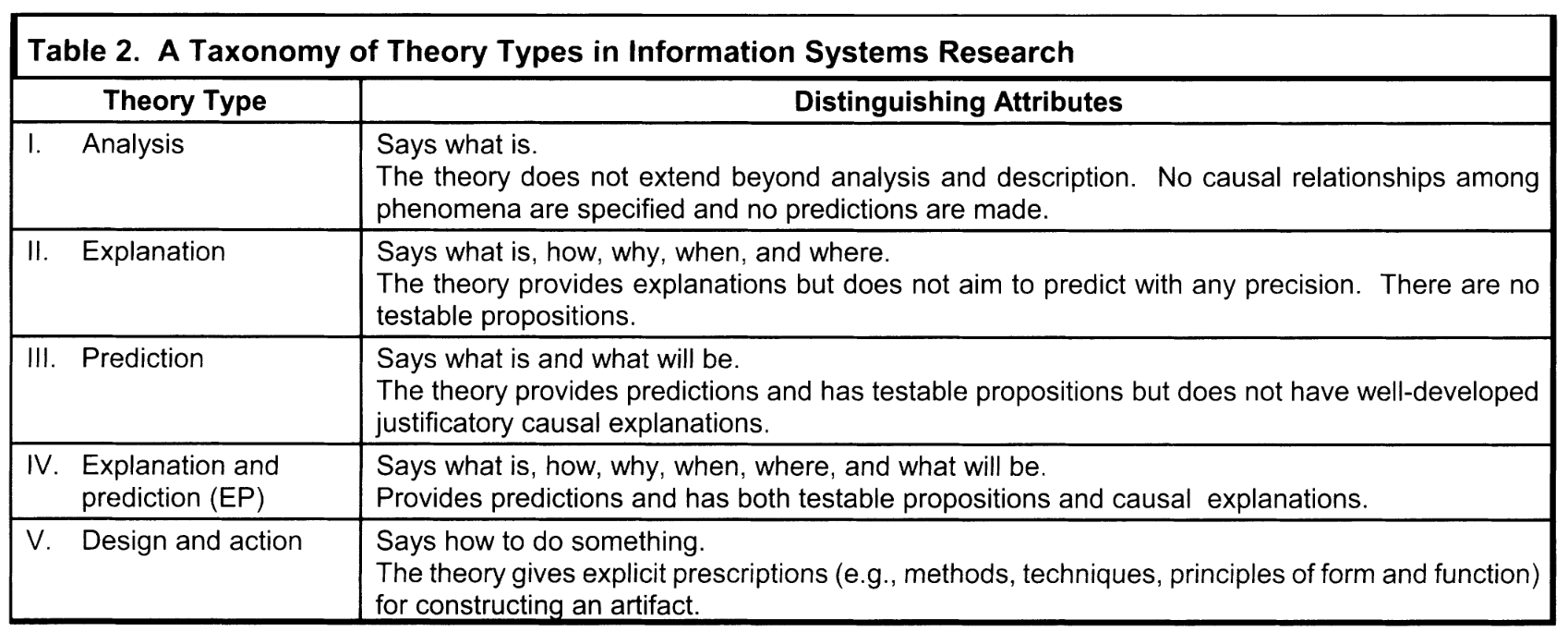
This is not a section of your thesis but is one of the most important aspects. When we do research, it should be informed by previous discussions in the same area. In other words, your research should not just be some random idea you have but connect to the broader academic discourse. Theory is how academics in the information systems domain make sure that they speak about the same thing. There are various theoretical foundations that you can use. However, some are outdated (e.g., Taylor’s scientific management) or overresearched (e.g., Technology Acceptance Model). Theories are not always called theories (e.g., resource-based view or dynamic capabilities). Sometimes, what we mean by theory is simply that your hypotheses are somehow backed-up by previous research. Sometimes we talk about earlier research results that we want to extend or refute. In other words, you should be able to justify what you are researching based on related work. Semantic search, such as ChatGPT, are a good starting point to engage with theories. Theories exist on various levels (individuals, organizations, markets). Make sure that the theory you use is suited for your research context. Further, make sure that when you engage with a theory you read the original paper that proposed the theory (often called a seminal paper), literature reviews that summarize the research in that theoretic space and a recent application (last 5 years) of the theory within the information systems domain from a journal on the Senior Scholars list. This should help you to decide how to engage with your theory yourself. If you’re doing a literature review, you create a descriptive theory and you will have to describe what theories are used in your references. On overview on theories can be found in and there is a table from the paper below.
- Foundations
Students are often concerned about writing a foundations chapter that, for instance, describes the chosen method in detail or the technology you use. We do not want you to do that! Describe how you use your chosen method and refer to methodological papers or books that describe the method and ideally to some other papers that use the method in the same way. Anything else, like background to your paper and so on should be brief and should be in the introduction or the related work.
Proposal
We expect you to write a short proposal of one page before starting to write your thesis. This is intended to make sure that you and your advisor are on the same page and have the same understanding on what you are about to do. We expect you to write your proposal yourself without the help of AI! We need to make sure that you understand what you are talking about and it is only one page. You are encouraged to already include related literature here. The proposal should have four equally long paragraphs:
Motivation: Why is your topic interesting? What’s the broad academic or public discourse surrounding the topic?
Problem/Research Question: What do we not know in the context of your subject? Why do we need to know it? What is the dependent variable, in other words, what variation in the real world are you researching in your thesis? Formulate a first draft of your research question. Make sure you have clarity on your contribution. Relate to the theory table above to understand what you are trying to do.
Objective/Hypotheses: Based on your research question, what do you expect to find? Formulate what we will know, once your thesis is written. You should be able to make statements on your expected contribution or your hypotheses based on what you find in your thesis. (Note that not every paper needs hypotheses. This is especially the case if you work deductively, i.e., you want to confirm or reject something. Literature reviews or taxonomies or even exploratory analyses typically don’t feature hypotheses but you still can describe the objective.)
Solution/Method: How do you answer your research question and confirm or reject your hypotheses? This is your method and data and you describe that in the last paragraph. A method is for instance, econometrics (i.e., data analysis), experiments, case studies, a literature review, document analysis...
Citations
We are mostly indifferent in what style you are referencing other papers. Usually, we will provide you with a paper or conference template that will specify the way, in which references are to be included. Just one small instruction: A reference always goes before the period (e.g., “[…](Adams et al., 2019).”) and if you are not referring to the author (which we don’t want you to do), the reference should be in parentheses. In LaTex this sometimes means using the \citep{} or \parencite{} commands. If you quote a paper directly verbatim, the reference needs to include the page number.
Length
There are no length requirements from us (there might be constraints from the journal of conference that your thesis is supposed to go to). Your thesis should be as short as possible but as long as needed. Length is usually not a good sign of quality. Being brief while being able to convey a message is the actual art of research communication. Einstein’s PhD thesis is only 17 pages long (look it up: Eine neue Bestimmung der Moleküldimensionen).
Writing your thesis as a paper (For Master thesis and ambitious Bachelor students)
It is our standard that the final version of your paper should be submittable as a paper to a conference. You will be given the format we are looking for in the beginning. Before you start writing, read at least five recent publications from this venue and make sure you have an understanding of what is expected there.
Submission
You need to submit your thesis to us. For archival purposes, we unfortunately need one physical copy. Don’t overdo the physical copy. Any format is fine. Make sure to be absolutely certain about your deadline! It is almost impossible to extend it if you hand in your thesis late and it might result in you having to write your thesis anew. You are required to submit all data, code or supplementary material digitally with the thesis. Therefore, none of this needs to go into the appendix but should be handed in separately. From your supervisor, you will receive an invitation to a bwsync folder, in which everything related to your thesis should be uploaded. That also includes all original versions of the references that your cited in your thesis. We will only grade your thesis, once all data has been uploaded.
Grading
We have set an internal deadline of grading your theses within six weeks. Please do not inquire about the state of your thesis before that.
Use of Supporting Tools
You are free to use any available tools that support you in writing your thesis. In fact, we encourage you to use these tools as assistants. However, the text from many of the AI models is usually not very good and its reasoning is horrible. It is highly speculative; it uses qualifying adjectives that should not be used in scientific writing and it generally tends to be too descriptive. If we identify passages that are obviously written by AI instead of just using the AI to improve your writing, this will impact your grade. Further, we will not accept excuses like “ChatGPT wrote this.”. If what is in your thesis is wrong, not supported by data or literature or exaggerated, this will impact your grade severely. This is also part of your learning experience to get a better grasp of how these tools can and cannot support you.
To make sure that you think through your structure yourself, you are required to submit two documents. One document that outlines your thesis in your own words in bullet points, text snippets, sketches. It can be German, it can be English, it can be mixed. It needs to reflect the story of your thesis. You are not allowed to use AI for this document. The second document is your thesis where you are free to use AI to help you formulate prose.
Resources
AISel Login: https://aisel.aisnet.org/cgi/myaccount.cgi
For access ask us directly.
For statistical analysis, use Python or R.
Format
The format will usually depend on the paper or conference you are preparing your thesis for. However, there are two components that are necessary to submit the thesis to the examination office: A title page and the declaration. Please find a template for both under the link below. Download the overleaf document (click on Menu in upper left corner) and adjust it to your thesis.
Title page and declaration: https://www.overleaf.com/read/vrdmjhdrpqkc#dbaadc
Supervision
You will usually have weekly or bi-weekly 30-60 minutes meetings with your advisor. This will be agreed upon once you decide to write your thesis in our research group. Your first reviewer is always Prof. Dr. Philipp Staudt and your second reviewer is Prof. Dr. Christof Weinhardt.
Grading criteria
We grade your thesis based on the following criteria:
- Thesis outline, argument, structure
- Introduction (motivation, theoretical lens, data and method description, research question, summary of results)
- Related work (command of literature, sufficient articles, recency of articles, information systems domain covered, if applicable: hypotheses derived)
- Data & Method (method justification, references for method, exemplary references for method, descriptive data representation, adequacy of data and method to research question)
- Results (properly described and derived from data, all results mentioned, correct use of terminology, proper referencing of research question)
- Discussion & Conclusion (critical reflection of all results, if applicable: all hypotheses revisited, research question properly addressed, results embedded and discussed in context of introduced related work, critical reflection of limitations, outlook addressing limitations?)
- Presentations
- Form (language, use and design of figures and tables)